

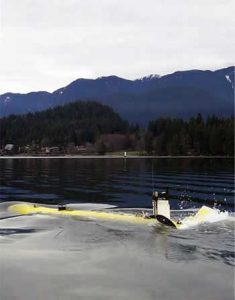
 ISE recently delivered an explorer autonomous underwater vehicle (AUV) to IFREMER, the French national oceanographic research agency. The vehicle was developed to meet IFREMER’s specific requirements following an international competition. The explorer AUV is 4.5 metres in length with a diameter of 0.67 metres. It has a weight of 750 kilograms and is capable of diving to depths of 3,000 metres. The vehicle was delivered to IFREMER’s Toulon, France, facility and then underwent a comprehensive set of sea-acceptance tests, which were carried out along with personnel training.
After a functional test at 2,500 metres was successfully completed, IFREMER commenced its first missions with the explorer AUV. According to ISE, modular design and the use of inexpensive materials for the payload section of the vehicle create an open architecture that permits easy re-configuration of the vehicle for a variety of applications and missions. In the same context, an open approach to software design avoids legacy problems and allows the operator to adapt the behaviour of the vehicle to meet new requirements. The vehicle features several innovations. These include a 1.1 metre telescoping communications mast which facilitates mission re-planning and also increases the communications range between the host ship and the vehicle. Also included is a 10.4-kilowatt-hour rechargeable lithium ion battery that can be discharged to 100 percent of its capacity and which carries a guarantee of 2,000 cycles. IFREMER also contributed to the development, particularly in the areas of vehicle positioning and recovery from small ships.